
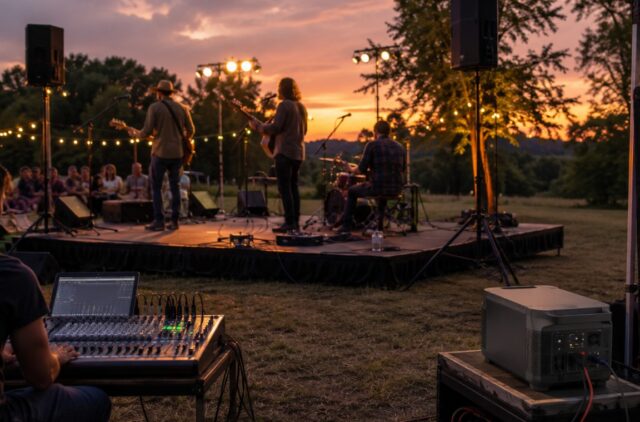
Outdoor performances need power that is quiet, predictable and matched to the equipment actually on stage. In 2026, that usually means combining several portable power sources rather than expecting one battery or generator to handle everything. Wireless microphones may only need rechargeable cells, while powered speakers, mixers, lighting and laptops can require hundreds or thousands of watt-hours. The best setup also depends on runtime, weather, transport and how much interruption the show can tolerate. The six options below cover small accessories through full event loads, with practical limits that matter before soundcheck starts.
1. Ni-MH rechargeable batteries for wireless gear and small devices
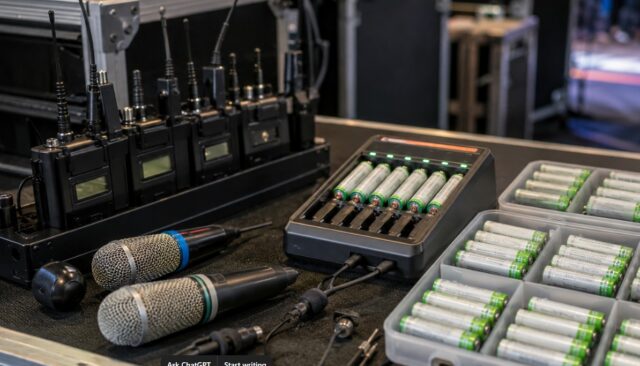
Ni-MH cells remain one of the simplest power choices for gear built around AA or AAA batteries. Nickel-metal hydride is a supported AA battery type, which makes the chemistry relevant for wireless audio rather than only household electronics.
A good nimh rechargeable battery setup is especially useful when a crew needs standardized spare cells for microphones, bodypacks, compact lights, tuners or similar low-draw devices. EPT offers individual cells and customized Ni-MH packs in multiple voltages and capacities, which can suit equipment that does not use ordinary loose AAs. For touring crews, consistent labeling and charging discipline matter.
- Best for repeat-use, low-power stage devices.
- Keep charged spares labeled by set or channel.
- Confirm the device supports Ni-MH before replacing alkaline cells.
2. LiFePO4 portable power stations for quiet AC power
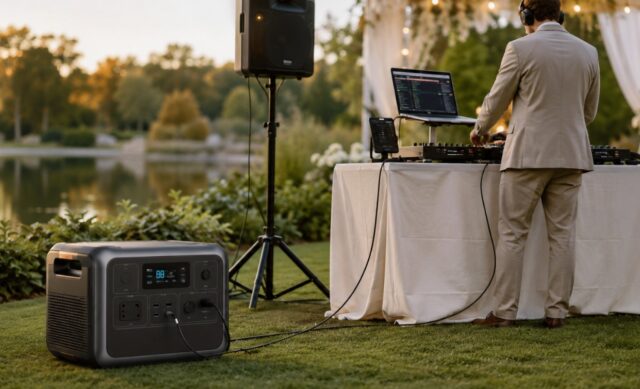
For small bands, DJs, wedding acts and mobile production rigs, a LiFePO4 power station is often the most versatile silent source.
Current models provide pure-sine-wave AC outlets plus USB and DC ports without engine exhaust or fuel storage. EcoFlow’s DELTA 3 Plus is rated at 1,024Wh with 1,800W of pure-sine AC output, while Jackery’s Explorer 2000 v2 offers 2,042Wh and 2,200W continuous output. Those figures do not translate directly into runtime because inverter losses and changing loads matter, but they give crews a useful starting point for matching capacity to a mixer, active speakers, backline electronics and control devices.
| Example | Battery capacity | Continuous AC output |
| EcoFlow DELTA 3 Plus | 1,024Wh | 1,800W |
| Jackery Explorer 2000 v2 | 2,042Wh | 2,200W |
3. Inverter generators when the event needs longer runtime
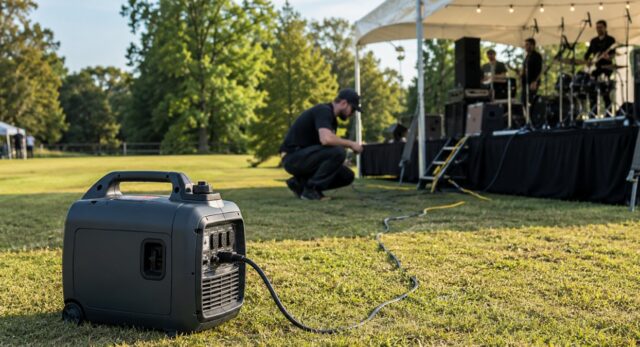
A fuel-powered inverter generator still makes sense when a show runs for many hours, the load is too large for a practical battery bank, or recharging opportunities are limited.
Honda’s EU2200i specifications list 1,800W continuous output, 2,200W maximum output, 3.2 hours of runtime at rated load and 8.1 hours at one-quarter load. For live audio, inverter models are attractive because they regulate their electrical output while also operating more quietly at lighter loads than many conventional open-frame generators. The trade-off is added planning for fuel, exhaust, weather protection and cable routing.
The U.S. Consumer Product Safety Commission says portable generators should run outside and at least 20 feet from a home, with exhaust directed away from openings. At events, keep combustion equipment well away from people and enclosed structures.
4. Foldable solar panels paired with a battery station
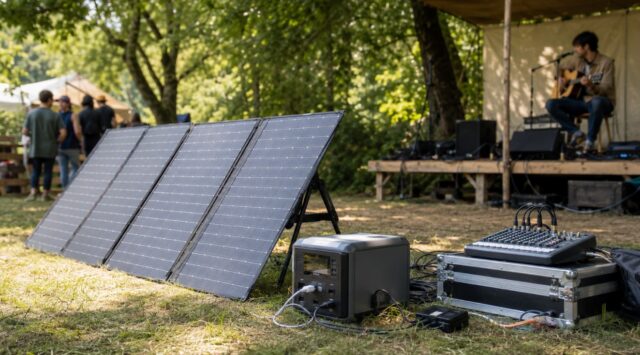
Solar works best as a way to extend battery runtime during daytime events, not as a guaranteed substitute for stored energy. A foldable panel can feed a compatible power station between sets or while the load is below the panel’s incoming charge rate.
The U.S. Department of Energy explains that real photovoltaic output changes with sunlight intensity, temperature, cloud cover and panel angle, so a “200W” panel should not be planned as if it will continuously deliver 200W. That makes solar particularly useful for multi-day festivals, remote acoustic performances, vendor areas and daytime production support where crews can recharge gradually without adding engine noise.
Did you know? Standard solar-panel ratings are measured under controlled test conditions. Actual field output is normally lower and changes throughout the day.
5. High-output USB-C power banks for control and production devices
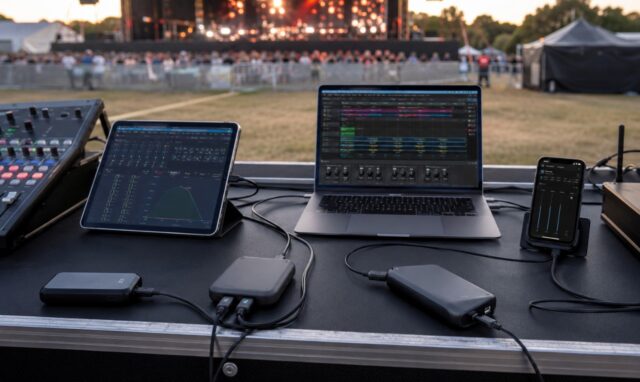
Not every part of an outdoor show needs AC power. Modern USB-C power banks can keep tablets, phones, cameras, laptops and some compact audio interfaces running without occupying outlets on the main station. They are easy to place at front of house, backstage or beside a tablet-controlled digital mixer.
Check both energy capacity in watt-hours and the maximum USB-C Power Delivery output required by the device. A bank that cannot deliver enough watts may charge slowly or fail to support a laptop under load. Separating these smaller digital loads from the PA supply also preserves stored energy for equipment that has no practical DC alternative.
- Check the device’s USB-C input requirement.
- Use properly rated cables for high-power charging.
- Reserve one bank for communications or show control.
- Keep consumer power banks out of rain and direct midday heat.
6. UPS-capable battery stations for mixers, routers and show control
A brief power interruption can be more disruptive than a gradual battery drain. Digital mixers, wireless receivers, network routers and playback computers may need time to reboot, reconnect or reload a session after power drops.
That is where a UPS-capable portable station becomes useful as a dedicated layer for control equipment. Jackery lists a switchover time under 20 milliseconds for the Explorer 2000 v2, while Anker lists under 10 milliseconds for its SOLIX C1000 Gen 2. Those specifications are useful, but they are not a universal promise that every sensitive device will ride through every transfer, so crews should test the exact rig before a public performance. Redundancy is strongest when show control and high-draw speaker loads are separated.
Practical note: Test the complete signal chain during rehearsal by removing the primary source and confirming that the mixer, router and playback devices stay online.
Frequently asked questions
1. Can a large portable power station be taken on a passenger flight?
Usually not. The FAA permits lithium batteries up to 100Wh, allows 101-160Wh batteries only with airline approval, and prohibits larger batteries. Spare lithium batteries and power banks must stay in carry-on baggage.
2. What does watt-hour capacity actually tell you?
Watt-hours measure stored energy, not maximum output. A 1,000Wh battery could theoretically supply 100W for 10 hours, but real runtime falls with conversion losses and changing demand.
3. How should spare batteries be stored between event weekends?
Follow manufacturer guidance, protect terminals from metal objects, and avoid hot vehicles or damp cases. Label packs by age so weak units can be retired before show day.
4. Does rain change which portable power option is safest?
Yes. Weather ratings vary. Protect connections and keep non-rated chargers covered. The same attention given to protecting music equipment from moisture matters even more with temporary outdoor power.
Build the power system around the show, not the other way around
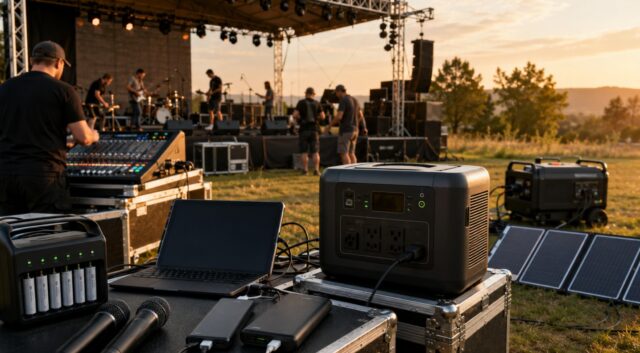
The strongest outdoor setup in 2026 is usually layered: Ni-MH cells for compatible wireless gear, USB-C banks for small digital devices, a LiFePO4 station for quiet AC loads, and either solar or an inverter generator when runtime demands it.
Keep show-control equipment on its own protected source, calculate loads before arrival, and test every transfer and backup during rehearsal. For bigger stages, temporary electrical distribution should be designed by qualified professionals rather than improvised from extension cords.
Once the power plan matches the actual equipment and event length, the crew can focus on the performance instead of watching battery percentages between songs.